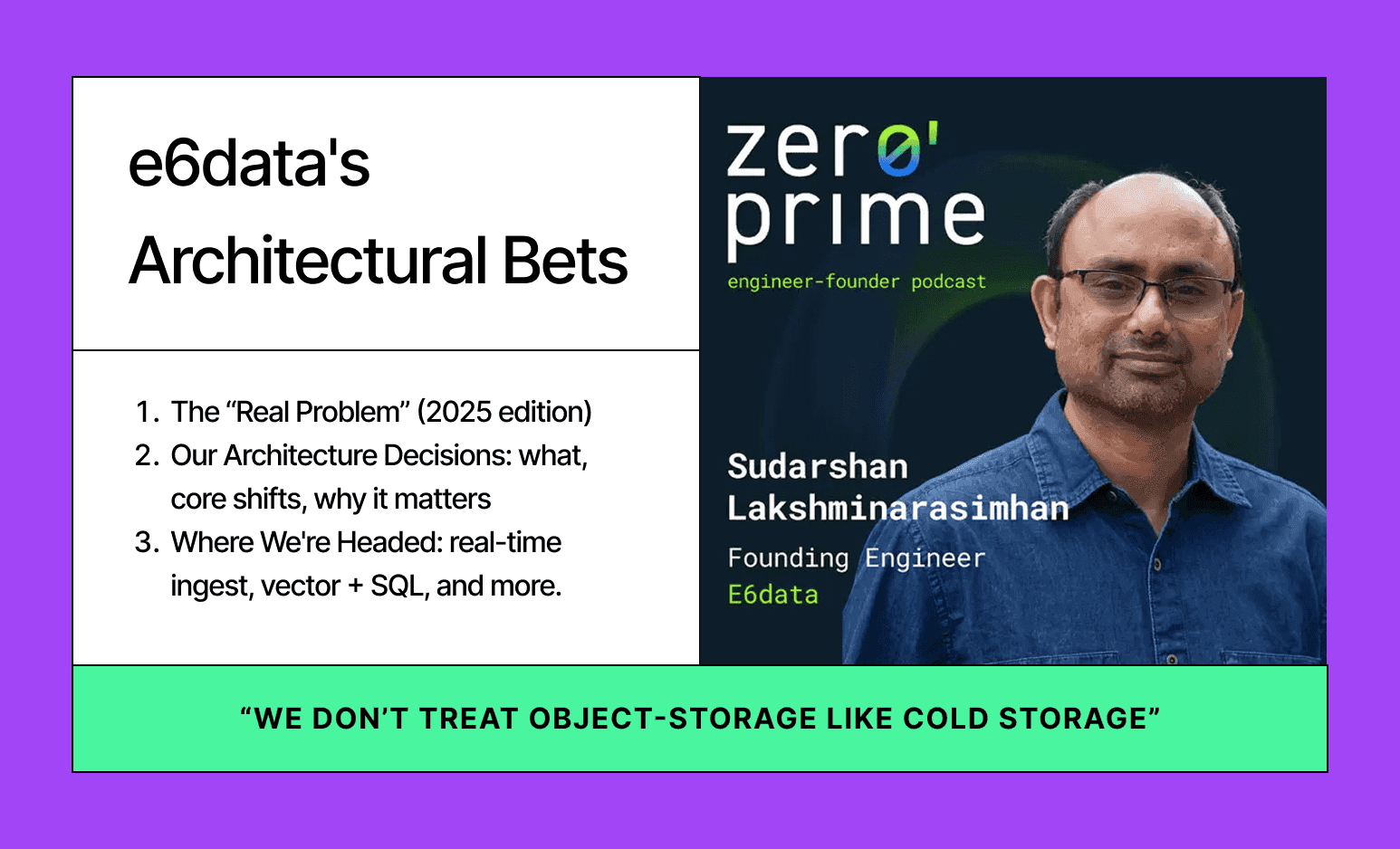
Our founding engineer and Head of Engineering, Sudarshan, recently went on the Zero Prime podcast and unpacked the internals of our compute engine.
Listen to the episode: Apple Podcasts · Spotify
“We don’t treat object stores like cold storage. And we don’t think your planner should be the bottleneck in a high-QPS workload.”
Sudarshan, Founding Engineer, e6data
It’s a story of breaking away from the driver-executor model, rethinking scheduling for the object-store era, and why atomic, per-component scaling actually matters.
The Real Problem (2025 edition)
Everyone says “compute and storage are decoupled.” Not really.
- You scale the cluster because some ad-hoc queries spike.
- That 10% of your workload defines your baseline cluster size.
- Your scheduler doesn’t react in real-time, so you over-provision just in case.
- You get 10% more queries, and you’re forced to double your warehouse size.
Today’s data infra ≠ Today’s compute requirements.
Our Architectural Decisions
We are building e6data by imagining a new playbook. No central coordinator. No one mega-driver. No lock-in to a single table format. Here’s the breakdown:
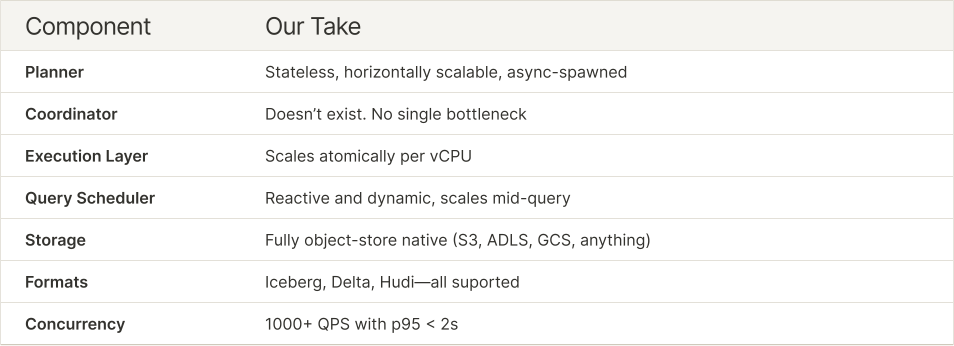
Core Shifts We Made So Far:
1. Disaggregation of internals
- Separate the planner, metadata ops, and workers.
- Each scales independently, not as a monolith.
2. Dynamic, mid-query scaling
- Queries can scale up/down during execution.
- No pre-provisioning for worst-case. Just-in-time compute.
3. Push-based vectorized execution
- We’re similar to DuckDB/Photon but go deeper on compute orchestration.
- Useful when dealing with 1k+ concurrent user-facing queries.
4. No opinionated stack
- Bring your own catalog, governance layer, and format.
- Plug in; don’t port over.
Feature
e6data
Legacy Engines
Scaling granularity
per-vCPU + component-aware
Full-cluster step scaling
Planner architecture
Stateless, elastic
Single-node driver / coordinator
Supported formats
Iceberg, Delta, Hudi (interoperable)
Often proprietary / locked-in
Cost-performance scaling
Linear with load
Non-linear + overprovisioning
Why It Matters
- Cost: We run 1000 QPS workloads at ~60% lower TCO than other engines.
- Latency: p95 under 2s, even with mixed workloads.
- No Lock-In: Use Iceberg today. Switch to Delta tomorrow. Doesn’t matter to us.
- Infra Reuse: Already on Kubernetes? Cool. We sit inside that.
Where We’re Headed
- Real-time ingest → queryable in <15s from object storage
- Vector + SQL → cosine similarity inside SQL filters
- AI-native enhancements → smart partitioning, query rewriting, and auto-guardrails